
Why the Next Big Tech Wave Is Growing from the Ground Up
If you ask most people where the next big tech opportunity in Asia is, they will probably say AI, fintech, or electric vehicles. Very few will immediately say agriculture. And that is exactly why AgroTech is becoming one of the most interesting and underestimated markets heading into 2026.
Agriculture is not new to Asia. It is the backbone of the region. What is new is how fast technology is starting to reshape how food is grown, moved, financed, and sold. Quietly, but steadily, AgroTech is turning into a serious business opportunity.
Let’s talk about what is really happening on the ground.
Asia’s agriculture problem is also its biggest opportunity
Asia feeds more than half of the world’s population. But the system is under pressure.
Farmers face rising input costs, unpredictable weather, water scarcity, labor shortages, and fragmented supply chains. On the other side, consumers demand better quality, fair pricing, and traceability.
This gap between demand and efficiency is exactly where AgroTech fits in.
By 2026, Asian agriculture will not be about producing more land. It will be about producing more value from the same land using data, automation, and smarter systems.
What AgroTech actually looks like in Asia today
AgroTech in Asia is not one single product or solution. It is a full ecosystem.
Here are the areas seeing real traction.
Digital farmer platforms
Apps that help farmers with crop advisory, weather alerts, disease detection, and price discovery are becoming mainstream in countries like India, Bangladesh, Vietnam, and Indonesia. Farmers trust tools that speak their language and solve daily problems.
Smart inputs and precision farming
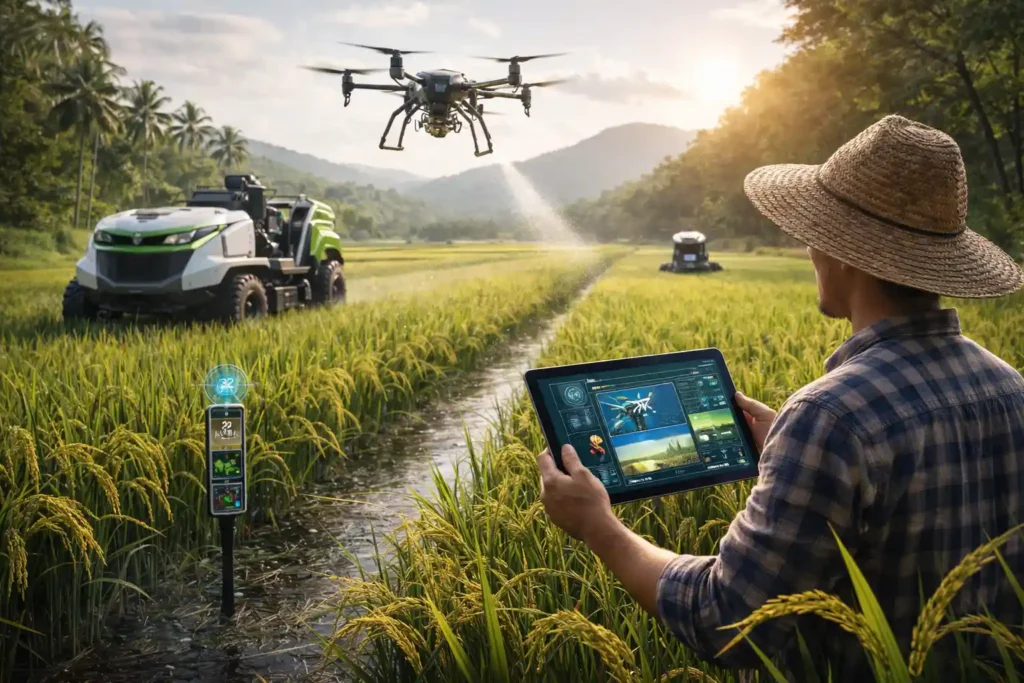
IoT sensors, satellite data, and AI models are helping farmers understand soil health, irrigation needs, and crop cycles. This is not luxury tech anymore. It is becoming necessary as climate patterns change.
Supply chain and marketplace tech
Farm to market inefficiency is one of Asia’s biggest challenges. Platforms that connect farmers directly to buyers, distributors, or processors are reducing middlemen and improving margins for both sides.
Embedded finance and insurance
Agro fintech is growing fast. Credit scoring based on crop data, weather based insurance, and instant input financing are unlocking capital for farmers who were previously invisible to banks.
Traceability and food safety
From export focused farms to urban consumers, demand for traceable food is rising. Blockchain and data tracking are slowly entering the system, especially in high value crops.
Why 2026 is a turning point
AgroTech has existed for years, but adoption was slow. That is changing now for a few key reasons.
First, smartphone penetration in rural Asia has reached a critical level. Farmers are connected.
Second, governments are actively supporting digital agriculture through subsidies, smart farming programs, and public private partnerships.
Third, climate uncertainty has made traditional farming methods unreliable. Farmers are more open to technology when survival depends on it.
And finally, investors are looking for real economy impact, not just digital hype. AgroTech delivers measurable value in food security, employment, and sustainability.
By 2026, AgroTech in Asia will move from pilot projects to scalable businesses.
The business side investors are watching
From an investor perspective, AgroTech checks several important boxes.
- Massive addressable market
- High frequency usage
- Strong retention when trust is built
- Real data moats over time
- Government and policy alignment
The key difference is patience. AgroTech is not a quick flip market. It rewards founders who understand agriculture deeply and build for long term impact.
We will likely see fewer flashy launches, but more steady growth stories.
Challenges that still need solving
This is not an easy market.
Farmer trust takes time. Rural onboarding is expensive. Hardware adds complexity. And every country has different crops, climates, and behaviors.
But these challenges also protect good businesses. Once a platform earns trust and integrates into the farming cycle, switching costs become very high.
That is why successful AgroTech companies tend to grow slowly at first, then very fast once they crack the model.
What the future looks like
By 2026, expect to see:
- AI driven crop advisory becoming standard
- Data based lending replacing guesswork finance
- More regional AgroTech champions, not global clones
- Stronger B2B platforms serving agro enterprises and processors
- Better income predictability for smallholder farmers
AgroTech will not replace farmers. It will make farmers smarter, more resilient, and more profitable.
Final take for TechInsighter readers
AgroTech in Asia is not a trend. It is a necessity driven market.
Food security, climate change, and population growth are forcing the system to evolve. Technology is no longer optional in agriculture. It is becoming part of the foundation.
If you are a founder, this is a market where solving one real problem can impact millions.
If you are an investor, this is where patient capital can create both returns and long term value.
If you are watching tech trends, AgroTech deserves a front row seat in 2026.
The next big tech story in Asia might not come from a skyscraper or a data center.
It might come from a field.

