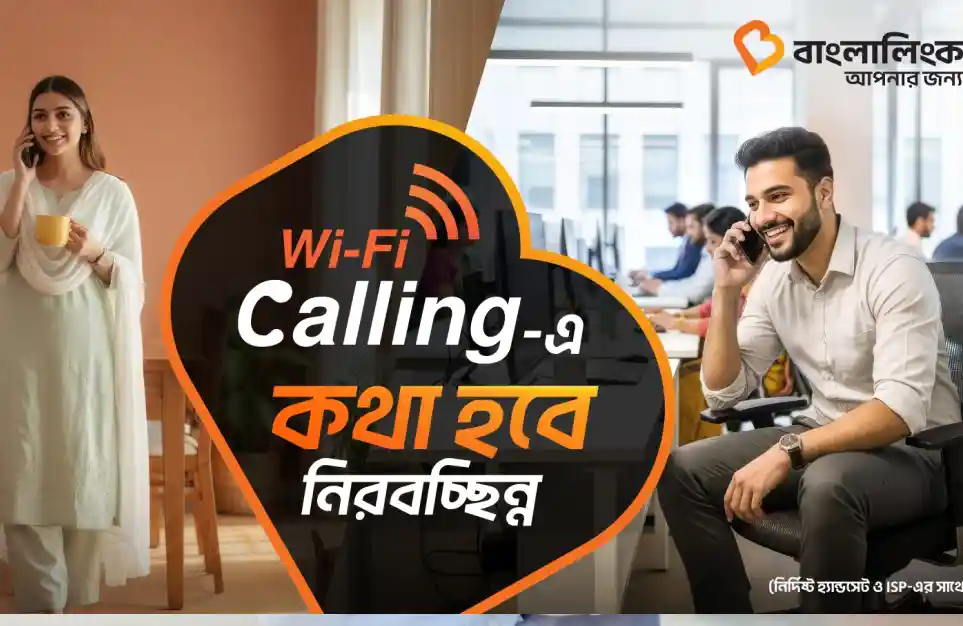
Banglalink has officially launched its nationwide Wi-Fi calling service, marking an important step forward for mobile connectivity in Bangladesh. With this move, customers can now make voice calls over Wi-Fi networks whenever mobile signal strength is weak, without changing how they normally use their phones.
For a country where network coverage can vary between indoor spaces, high-rise buildings, and rural areas, this update is more practical than it might sound at first.
What Is Wi-Fi Calling and Why It Matters
Wi-Fi calling, also known as Voice over Wi-Fi or VoWiFi, allows your phone to route voice calls through a Wi-Fi network instead of relying only on mobile towers. If your cellular signal drops or becomes unstable, your call automatically switches to Wi-Fi while keeping the experience exactly like a regular phone call.
There is no app to install, no separate login, and no change in how you dial numbers. To the user, it feels seamless.
For Banglalink customers, this means clearer calls indoors, fewer dropped conversations, and better connectivity in places where mobile signals struggle but Wi-Fi is available.
From Pilot to Nationwide Launch
Banglalink did not roll this out overnight. The company introduced Wi-Fi calling on a pilot basis in September 2025, testing the service in selected areas of Dhaka, Chattogram, and Khulna.
During the pilot phase, Banglalink evaluated real-world performance and gathered customer feedback to fine-tune the service. According to the company, this testing phase helped ensure stable call quality and smooth switching between Wi-Fi and mobile networks before expanding nationwide.
With those optimizations in place, Banglalink has now made Wi-Fi calling available across Bangladesh.
How the Service Works
The system is designed to be simple and automatic:
- Calls route through Wi-Fi when mobile signals are weak
- Calls behave like normal voice calls in every other way
- Switching between Wi-Fi and mobile networks happens automatically
- No apps, no extra authentication, no new dialing methods
From the user’s perspective, nothing changes except better call reliability.
Device and Network Availability
At launch, Wi-Fi calling is available on selected smartphone models that meet regulatory requirements. The service also works through selected ISP partners.
Banglalink says it is actively working with device manufacturers and internet service providers to expand compatibility. The goal is to make Wi-Fi calling available on more handsets and networks over time, while staying fully aligned with regulatory guidelines.
So if your phone does not support the feature yet, that could change soon.
Why This Is a Big Deal for Bangladesh
Banglalink is one of the largest telecom operators in Bangladesh, and its nationwide VoWiFi rollout reflects a broader shift in how mobile networks are evolving in Asia.
As data usage grows and people spend more time indoors, relying solely on traditional cellular coverage is no longer enough. Wi-Fi calling helps bridge that gap by combining mobile and broadband networks into a single calling experience.
For users, this means fewer missed calls, clearer conversations, and more dependable service in offices, homes, shopping malls, and high-rise apartments.
What Users Should Expect Next
In the coming months, customers can expect:
- More supported handset models
- Wider ISP partnerships
- Continued improvements in call quality and reliability
As awareness grows, Wi-Fi calling could become a standard expectation rather than a premium feature.
Final Take for TechInsighter Readers
Banglalink’s nationwide Wi-Fi calling launch is a practical upgrade that directly improves everyday communication. It is not about flashy new apps or complex features, but about making basic voice calls work better in real life situations.
For Bangladesh’s mobile users, especially those who struggle with indoor signal issues, this service could quietly become one of the most useful network improvements in recent years.